The best classical album I heard in 2025. Alice Sara Ott is amazing.
Tag: music
Pol – Modern Strange Love
Akai MPK Mini Play Mk3
Santa (AKA my wife) brought me an Akai MPK Mini Play Mk3 for Christmas this year.
The Mini Play is a MIDI controller with the functionality of a standalone keyboard. MIDI controllers are usually designed to plug into computers and used to manipulate sounds in DAWs and plugins. On its own MIDI controllers do not have the ability to generate sound.
Because the Mini Play has a bank of sounds as well as a speaker it is like what is usually called an electronic keyboard. The Mini Play as a keyboard is made all the more versatile because of the headphone jack, battery power capability, and the sound bank and speaker mentioned before.
Who is this for?
This is the first time for me to buy a synthesizer, if you may call it that. I will because it has many of the traditional controls found on synthesizers to sculpt the sound.
It has digital instruments, everyday sounds as well as synth sounds. Especially with the synth sounds you can have fun sculpting.
This is very much a keyboard/MIDI controller for someone starting out with electronic keyboards and synthesizers.
Controls
It has controls such as filter, resonance, reverb and chorus, attack, release, EQ for low and high. It also has arpeggiator functions. Notably missing are the decay, sustain, portamento controls.
It also has drum pads and built-in sounds for percussions.
Plug in is simple. An old school printer port goes to a USB which can be plugged directly into a computer or charging port.
First impressions
I have played instruments (piano traditional and electronic, marimba, guitar, cajon) before but this is the first time for trying synthesizers.
My ideal was to have a standalone keyboard to just play and learn but also to integrate with a computer to make music. I had considered electronic keyboards with fixed sounds and synthesizers. But I was quite sick of normal sounds and had an urge to recreate sounds from my favorite songs from the 80s, predominantly New Wave, New Romantic genres. Proper synthesizers were intimidating and expensive. This was a compromise of function, cost effectiveness and versatility.
As a standalone it works great. Best with monitor headphones and plugged in to a power source. the sculpting is limited but enough for me to learn how synthesizers work. The drum pads are great. Again, having that extra function makes it fun. Using the arpeggiator with both keyboard and drum pads means I can easily whip up a beat and play some accompaniment.
The easy hook up to a DAW (MPC Beats included in price) was surprising. However, learning to use the DAW is a steep learning curve. But it is probably simple basic enough for a beginner like me.
Conclusion
This keyboard/MIDI controller was exactly what I was looking for, something to recreate the sounds and music I like and listen to. It is extremely affordable at under USD200. It is can be used anywhere to think of ideas because of the built-in sounds and speaker. But also I can connect it to a computer and a DAW (included) to record music.
It is easy to use. Mini Play does not have more than two layers of menus to navigate. The layout is easy to understand with everything labeled clearly. A quick read of the short instruction manual was all that was necessary to get started with every function.
Again, who is this for?
If you are a beginner to music creation and have that itch to scratch, and your itch has to do with pianos and keyboards then this is a good buy. Not the best build quality but it is as good as a sub-USD200 can get. Being able to play music without a computer is a bonus since MIDI controllers generally do not have this functionality. This is two devices in one machine. It is a MIDI controller and it is an electronic keyboard. It is a basic synthesizer for those who want to learn about synthesizers.
Buy it and have fun.
I was wrong about digital music
Up to now I have complained about digital music. I complained that it didn’t sound as good as compact discs or records. But this is only true under certain conditions.
When I try to play digital music through an old school system (either through MDF speakers or wired headphones) the sound is average to say the least.
I bought a pair of apple 2nd Generation AirPods Pro recently and playing the same music through either the AirPods instead made the same piece of music sounds much better and natural. In fact it made music enjoyable again, reproducing the nuanced sounds more naturally.
In short, digital music from my phone is supposed to be played through something like AirPods which are designed for digital music. Old school speakers and systems are made for analog music. CDs are also designed to be played through such systems for which they were adapted.
Subtlety in analog music
I am convinced that we have sacrificed convenience for quality when it comes to recorded music.
Listening to Bruce Springsteen’s The River album I cannot help but feel that each instrument comes out so much clearer on vinyl than on streaming even though the streaming is lossless.
So what is lossless but pumping up all values of the sounds until they get in the way of each other. I suspect it is the same with compact discs as well. The subtlety of loudness is lost in digital music, or rather the softness is lost because the values are increased to be as loud as the loudest parts of the music.
There is a lot more detail in the analog playback.
Yard of Blonde Girls
“Through the yard, through the yard of blonde girls. Through the river and the sea, gold sharks glittering, a tree of white breaks the earth. The streets where Lola played. Very sexy. Very sexy.”
Jeff Buckley
The scary thing is I’ve met people, been to parties and places like these.
Onkyo HF Player
Every time I play Beck’s Morning Phase album I notice it always sounds crisper and more defined in through the Onkyo HF Player instead of Apple Music. It is the app and not the file quality because I bought the original download from Apple Music and not elsewhere. So the only variable is that of the app. In other words it is the algorithm of the app that makes the sound quality better.
While I enjoy the convenience of Apple Music it is ultimately the sound quality that is important. In general, the audio sounds flatter and with less definition in Apple Music. This is not noticeable except through contrastive comparison. But still I would probably enjoy it less subliminally as I do notice the difference. Apple Music sounds lacklustre.
Why buy physical music? Because it is better!
When was the last time you considered buying a stereo? In fact, the term “stereo” just seems so dated. Most people these days listen to music on bluetooth headphones or speakers. But they are missing out on a lot. Or if they are listening to subscription streaming audio then maybe not. Let me explain.
Subscription-based music streaming services like Apple Music, Google Play Music, Amazon Music or Spotify use low encoding bit rates. Typically a compact disc is at 1411.2 kbit/s while Apple music is at 256 kbit/s. This means a compact disc is playing 5 times more information per second than the same song streamed from Apple Music. Spotify is only slightly better than Apple in this respect at 320 kbit/s. Only Tidal and Amazon Music HD gives CD equivalent encoding bit rates. But this would also mean fives times more bandwidth is used.
But what does this all mean? Well, if you are listening to your music on the standard issue Apple headphones this does not matter much, since the headphone cannot produce the dynamic frequency range of the audio. This is also true of bluetooth speakers which not only does not cover the spectrum but also does not produce stereophonic sound well.
Which is why I am talking about the Kenwood K-515 here.
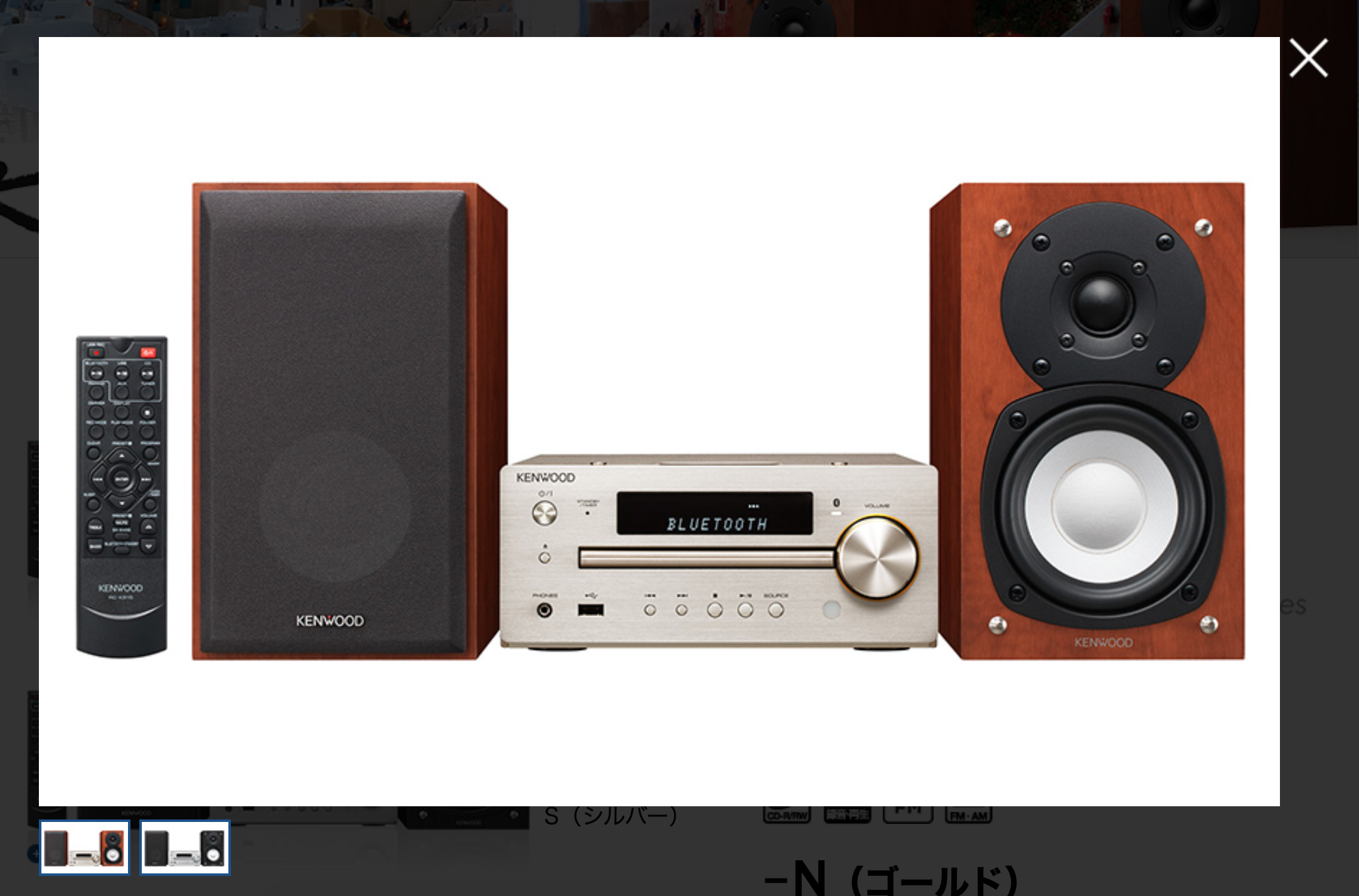
This is a stereo or a hi-fi.
While this is a current incarnation of the old-school system it does what stereos were supposed to do – reproduce high quality high fidelity sound. You will notice in this shot that the display says “bluetooth”. So this is not an old school hi-fi with some new trick up its sleeve.
As I said, the problem is, firstly, the source of the music. If you stream Apple Music on the K-515 it sounds pretty good, in fact, much better than on standard headphones (maybe not high end bluetooth headphones). But it will beat the bluetooth speaker hands down.
There is something about stereophonic sound created by two speakers. It has depth. It isn’t mono.
It gets better
But not only do we have stereo we can also play back more information. Playing a compact disc version side-by-side with a streamed version one will notice that the sound is also richer with the CD. The loss of information depth (if you will) means the “in between” sounds are lost. This why we should return to at least CDs. There was/is nothing wrong with CDs at all.
What went wrong with music was music piracy and then download purchase model. Yes, Napster made sharing music a whole lot easier. That started the decline. But Also, as a knee-jerk reaction, download purchase of music also meant people no longer bought albums, but individual tracks. In other words, sales of music moved towards singles. This lowered volume of sales thus hurting the artists.
How to view streaming in 2020
So, is streaming bad? I don’t think so. Whereas I used to visit the record stores regularly to see what was new and randomly discover music and artists I like, this did not happen once physical sales disappeared. That is, until subscription streaming.
With a subscription service it is now like having a listening booth in your house. But after I had bought the K-515 the quality of the recording began to matter again. Simply, I have now returned to buying CDs and records because they sound so much better. Occasionally I buy hi-resolution tracks online but nothing beats having a physical album.
When you buy an album you are buying more than just the music. You are buying the artwork, the additional relevant information, and the knowledge that it is yours forever. that is part of what music means. People spent a lot of time thinking about the cover art and design of the album. This is part of what music is about.
Apart from there being very little price difference between downloaded album and physical one you get nothing but the music with download. Someone is pocketing that money for so much less work. Physical albums, comparatively, are value for money.
I have not enjoyed listening to music in such a long time, all it took was an investment in the right equipment and an understanding why a good source and hardware are necessary.
Incidentally, that stereo cost the same as a “high-end” bluetooth speaker. So, why would I want to buy a (mono) speaker when I can have a stereo? None, whatsoever.
Back to basics with music – buy a “stereo” stereo
I believe we have forgotten the fundamentals of music.
Sound is three-dimensional, and embodied. We have not one but two ears for a reason. Sure, stereo headphones will produce stereo but not three-dimensional sound. The stereophonic sound remains the same even if you move your head to face any direction. Not so with live performances or speakers spaced apart.
While it can be argued that an all-in-one unit player/speaker is located in a space it does not produce stereophonic sound very well. Firstly, the speakers are too close together. Whatever stereo sound you have it may as well be a single speaker. Secondly, today’s digital streaming music is less detailed and dynamic than the original recordings. The combination of these make for a flat and unenjoyable music experience.
It is a mistake to think playing music loud will make it more dynamic or detailed. If the data is missing detail (and therefore dynamic) no matter how good your equipment is, it will output only what it is input into it.
This means there are at least four factors which will determine how good the music will sound. These are 1) the recording equipment; 2) the amount of data preserved; 3) the processing unit or amp; and 4) the speakers.
I have a recording of Rachmaninoff playing his own Piano Concerto No. 2 but because it was recorded in the early 20th century the amount of detail is low. Similarly, the standard digitally streamed music is of a lower sample rate as well as bitrate. Both of these impact on what can be reproduced. Today while I have a decent stereo in the form of the Kenwood K-515 it still produces, in the eyes of an audiophile, well under the kind of sound that can be considered optimal or perfect. But then again, I am not spending thousands but hundreds of dollars here. For the price I paid that is good enough for me.
Buying a DSD recording of Norah Jones’s Don’t Know Why and playing that on the stereo made it so wonderful that I must say that it was value for money.
Regurgitator’s Pogogo Show – a review
The Song Formerly Known As was the first song that made me aware and like (love) Regurgitator. That was back in the late 90s. And my opinion of them has not changed since. They are what we like to call “big kids”. And this latest album – Regurgitator’s Pogogo Show (iTunes) is another example of their playfulness.
Regurgitator collaborated Australia’s national television and radio service, Australian Broadcasting Commission, to produce an album for children (perhaps for the first time in their careers) and one that is relatively children-friendly … for their standards. The iTunes blurb points out without exaggeration their style which traverses punk, pop, electro, rock, hip-hop and funk. Regurgitator often, if not always, do this on a single album (and sometimes in a single song) without missing a beat. The blurb continues with where the inspiration came from (a toned-downed kids show they did of their songs in 2013). Their music is regularly a pastiche of music history genres. And on this album they have not deviated from this successful formula.
The album is a 17-track monster, moving along dizzyingly from Zelda-inspired RPG music, to rap, acid jazz, punk, computer-game funk, guitar-driven punk, light Japanese Cornelius-like indies, crazy-Bob country, garageband, old-school gangsta-rap, Ramones-punk, RPG story, Miami Vice intro-ed hip-hop song, a ukulele song, Shonen Knife punk, Cuban rumba, and ending with a clearly Kraftwerk-inspired electronic track.
The Gurg (as they are known to fans) are as cheeky as ever, toying with sounds that only they can. Having not lost any humour with age they have blended various styles effortlessly to create an album not only will kids enjoy (elements of The Wriggles) but also something for the adults who ultimately fork out the money. While the lyrics are written for kids in mind a couple of tracks will draw more than a giggle from adults. Mr Butt and Farting Is a Part of Life placed towards the end of the album will educate children empathy and reality. A well thought-out album collaboration that not only highlights the quality of Australian music (especially music for children), Australian values, but also just how underrated and misunderstood Regurgitator are. And this can be considered their first foray into the mainstream music consciousness.
This is only an album Regurgitator can make. They have not returned to being children because they had never left. While the fortunes have not been with them it is perhaps time to revisit some of their older works. Recommended is Dirty Pop Fantasy (iTunes). Thoroughly postmodern in the positive sense of the word, they have created an album which introduces to the next generation a breadth and variety of music that no other band could pull off, all the while being entertaining.
All tracks, except for the last track (The Robots), are under three-minutes long as appropriate for a children’s album.
Rating: 4.8 out of 5.
Tracks
- Fanfare Intro (0:34)
- Pogogo Show Theme (2:24)
- Favourite Song (2:05)
- I Don’t Wanna Dog (2:21)
- Games on My Computer (1:46)
- Pillow Fight (0:57)
- The Morning Theme (1:01)
- Pigeon Riding on a Motorcycle (2:34)
- Party Party Party! (1:34)
- The Box (2:23)
- Ghost Cat (1:55)
- Pogogo Show Story Time (2:09)
- Mr Butt (1:12)
- Farting Is a Part of Life (1:38)
- Best Friends Forever (2:15)
- Curumbo! (1:06)
- The Robots (7:05)
 signature103