I have come to the conclusion that nothing exists except for the physical world. The mind is a product of an object, namely an body. A personality is a product of the mind. This evidentially converges with the Buddhist concept of non-self (anatta). To me, what is called the ‘self’ is not what it seems. It may be considered a kind of illusion.
Tag: philosophy
I love Kant, the later Wittgenstein, Derrida, post structualism, postmodernism and the philosophy of language.
Philosophy from looking at a piece of paper
The Zen buddhist Thich Nhat Hanh once spoke of the impossibility of looking at a piece of paper seeing its front face and not presume that it has no back face. Most people will not argue that. Intuitively we will presume this, if we are of sound (without mental disabilities) and mature (old enough to have enough experience) mind.
Maurice Denis began a revolution in Western art with this insightful statement,
« Se rappeler qu’un tableau, avant d’être un cheval de bataille, une femme nue ou une quelconque anecdote, est essentiellement une surface plane recouverte de couleurs en un certain ordre assemblées. »
“Remember that a picture, before being a battle horse, a nude, an anecdote or whatnot, is essentially a flat surface covered with colors assembled in a certain order.”
which led to (or summed up) pretty much all modern art. The Cubist paintings of Picasso are an expression of this idea. And Cezanne tried the same in his still-life works before Picasso.
In literature, Eliot, Woolf and Joyce are good examples of this approach and understanding. In linguistics, Saussure said as much about meaning in language. And in philosophy, Wittgenstein, after Tractatus Logico-Philosophicus, and Derrida had pursued an understanding to the same end.
In Zen, all things are linked, and all things are empty. The back of the piece of paper can be safely presumed to be there even if we do not directly see it by virtue of the existence of the front of it. The back relies of the front for its meaning and existence, as does all language relies on all words for each other’s definitions. Nothingness only means what it does because of somethingness. The reverse is true as well.
Materialism must take precedence
If life, in the form of a non-material entity, can exist independently then there would not be a need for a physical being in the first place. The simpler solution is usually the most economical. So life must require a physical form to exist in the first place. The mind or soul is therefore a product of the body, not the other way around. Nor is the mind/soul independent of the body.
Yet, the body is what produces the very illusion of the soul in the first place. It is a part of the material world and it is a necessary part of our humanness. Without this we would not know what we know, and we would not live how we live. That is the irony of the mind and body.
Ergo cogito sum
The more I think about it the more I come to the conclusion that Descartes has it wrong. It is not cogito ergo sum (I think therefore I am) but ergo cogito sum (I am therefore I think).
It is the sensing then perceiving that makes the world. Without this contact between the object world and the mind objects nothing would derive any meaning from an inanimate world.
All that I am is this perception of my relationship to the world.
Meaning
You know, nothing really has meaning.
What I mean by this is that within context things make sense. But what if you expand or contract the context? The meaning changes. So this in itself is an indication of the inherent instability of meaning.
So meaning is contextual. It is empty of any independent “substance”. Nothing new about this. Socrates said something similar about words in Cratylus. As did Buddha. And so the jump to this conclusion is not hard to reach.
Not ‘if’ but ‘when’
Death is not a question of if but when. Framed this way, then, there is nothing to fear about death, and one can get on with life and live it to the fullest.
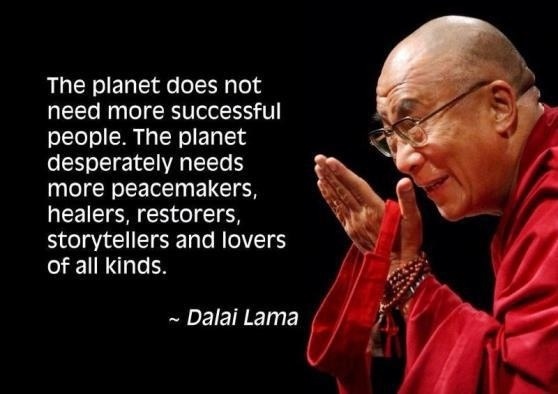
What the world needs
Buddhism isn’t a philosophy
In this talk Thich Nhat Hanh said that Buddhism isn’t a philosophy but that it has philosophy in it. There is a minimum of knowledge of the world necessary in order to follow the Buddhist practice but after that we should get on with the practice and not dwell on philosophical speculation.
Thich Nhat Nanh talks about the much quoted Cula-Malunkyovada Sutta:
“Malunkyaputta, it’s not the case that when there is the view, ‘The cosmos is eternal,’ there is the living of the holy life. And it’s not the case that when there is the view, ‘The cosmos is not eternal,’ there is the living of the holy life. When there is the view, ‘The cosmos is eternal,’ and when there is the view, ‘The cosmos is not eternal,’ there is still the birth, there is the aging, there is the death, there is the sorrow, lamentation, pain, despair, & distress whose destruction I make known right in the here & now.”
Adam Phillips on happiness, pain, satisfaction, and attainable ideals
What Adam Phillips, a psychotherapist and writer, says in this interview is, in my opinion, excellent and very close to Buddhist thinking.
 signature103