In “lesser” news (those that are not reported as much because other “more important things” are in the news) floods in Indonesia’s Aceh Tamiang district have killed over 120 people. Neighbouring Malaysia’s Meteorological Department has labeled it as “extreme” weather phenomenon and has issued warnings as already 90,000 people in the country’s south as been displaced.
Category: buddhism
This category is about everything Buddha and Buddhism, which teaches that:
1) everything is marked by impermanence, to believe in any permanence is to suffer, and the the ultimate cause of suffering is the rejection of the non-permanent self.
2) Enlightenment (contentment) can be found through the understanding of the true nature of existence (trilaksana) as stated here, and by living in accordance to such an understanding.
Saddam’s death and karma
Saddam’s death seem to bring joy to most, and hate and vengence to others. So just when is this karma going to stop?
While his death may have been his own doing through his karma, it is not for us to continue our own by rejoicing his death. Our own karma will only come back to us.
This is why I hate politics.
We can only work to free ourselves and no one else.
Polar bears and skiing
What a week for global warming.
The Bush Administration has finally agreed to look into protecting polar bears. This move only came after much pressure from a lawsuit which found the polar bears were not adequately protected by government policy from the effects of global warming on their habitat. All the while groups from within the Bush Camp still believe that greenhouse gas emissions is not the cause of the rapid lost of Arctic ice threatening the bears’ way of life. Gas and oil drilling in Alaska will continiue until a clear picture comes from a 12 month study.
So, tell me Mr. Bush, how many signs do we need before you realise that global warming is actually happening? And how deeply we have to get before you – the leader of the nation with the greatest output of greenhouse gases, as well as, the leader of the nation which exercises such power only because of “economic” wealth – will listen to the drowning cries of the bear (and perhaps the people whose houses will be below the sea level)?
I just hope you, Mr President, are not going to the skiing World Cup this week. In case you haven’t heard they haven’t had much snow in Europe. Bormio, Italy, where one of the events is being held, had to bring in forty-seven (yes, 47) snow cannons to produce 100,000 cubic metres of artificial snow due to the lack of real snow.
Do we need any more signs before we realise global warming is here?
Reviving literature
The trend today is to teach and learn only the practical. Does this spell the end for the teaching of literature in the langauge classroom?
My teacher in my teaching materials class made a comment about how one of his colleagues is lamenting the lack of literature in langauge teaching today. With the emphasis now on communicative grammar, poetry, short stories and novels have all but disappeared from the langauge classroom.
But only as recent as fifteen years ago it was still different. During my undergraduate years I studied Japanese. It was expected that one studied Japanese literature. It was not because literature would help directly with communication, but rather we were reading what the Japanese were reading. It is was this kind of authenticity which helped us understand the Japanese and their culture. Certainly my Japanese vocabulary is better for it today than if I did not read Japanese novels. Where else would come across words teppatsu (elms bowl for Buddhists teaching exchange for food) or learn about sabi (rusticness. But it means much more than this and as an Japanese cultural aesthetic, inseparable from their identity).
Literature therefore teaches you more than language. It teaches about culture also. And in some ways langauge is culture. How else would I learn these things except for novels. While in this age of fast pace and quick and efficient solutions I still believe the quality of learning gained from just a few pages of hard and studious translation is worth more than, say, a week in Japan observing only and trying to find hints of meanings from gestures and practices. I feel books – any books in the target language – are undervalued as a resource. Books need not be especially designed for language to be useful. If anything they are better because they are authentic.
But coming back to the language teaching, textbook writers and publishers highlight this point. For if ordinary books are seen as good as (or better than) specific-purpose textbooks then these publishers’ and writers’ potential market to sell becomes smaller. In other words there is a hidden agenda to the reasons to promote textbooks in this way.
Twenty years ago still we saw literature as an important part of language learning. But communication was also taught if we were to go into the real world and mingle with real Japanese. However, today you can talk to a non-native speaker of Japanese and he or she will almost know or say nothing of Japanese culture or literature, but talk only about her or his country or about his or her opinion. If this is what internationalization means then I do not want to be part of it.
Since literature is still being read widely today it is not that troubling. Sooner or later the pendulum will swing back and literature will once again become fashionable, that is, until it is overdone, again. Remember this: trends are so predictable in this way, and how we teach is also nothing but a trend.
The Earth, its environment and resources
Recently I had to evaluate a writing textbook for my Teaching Writing class. It was a textbook for teaching English writing to second language students for academic purposes. So the articles were all social related.
The chapter I chose to examine was called Our Earth, Our Resources, Our Environment., a chapter obviously about sustainability issues. Yet the title struck me as problematic. Not that the Earth the resources and the environment are unimportant words (they are undoubtedly “trend words” for today) but it was how they were determined. The other three words or to be exact the other word repeated three times – our – was just begging for criticism.
Of the three possessive cases that occurred in this short “punchy” title resources stood out for me. What are resources and who owns them? These are questions I would like to answer here. The Oxford English Minidictionary on my desk defines resource as “a supply of an asset to be used when needed”. A fair and straightforward definition. But what about the assumptions of the word. The use of the words supply and asset are interesting here because they are not words usually associated with the environment, especially the protection of it.
And what about the verb form? It is in the passive. Passive sentences have a feature which make it a favourite of some writers because of what it can hide or ignore – the doer. To complete the definition it omits the doer partly because it is assumed and partly because it wants to obscure its negative impact. Let me put it another way: I do not know of too many animals that see the trees and mountains as “supply”, “asset” or “resource”. These are wholly human terms.
Habitat may be a better word to describe the areas we term resource. But that too has its problems. It is always “the dwarf mongooses’ habitat” or simply “their habitat”. usually it is not an area human inhabit but always a step removed from, or to look at from the outside. In other words, it is the The Other world or place and not ours.
About five minutes drive from my home is a quarry. I literally drive through it almost everyday to get to and from college. Every time I do so I shudder. Slowly what once was a mountain, a forest and habitat for animals is now bare yellow sandy rock. The huge bulldozers power shovels and dump trucks that sit by the roadside has gradually been transported away to some factory somewhere for use, for human consumption. The mountain face that once dominated my peripheral vision as I drive now opens up to a dusty sky. How sad. I wonder if the workers don’t feel any loss by this. I do. But I guess it represents food on the table for them.
Last year I wrote a very short piece about Proudon’s famous statement “property is theft”. In this piece I deconstructed the term property and turned it on to itself, saying we are really stealing from ourselves. I still feel the same way now but I must qualify it. Not that I am an anarchist or believe in anarchy (not in the popular meaning of the word anyway), rather the things in the environment do not belong solely to us, the human species.
Animals, I feel, have the right to the use and protect their home and the place which feeds them. This may be a mountain or a forest, the very place we call a resource, our resource. Yet they literally do not have representation. Animal rights groups may attempt to speak for them but it may seem – to the other on the other side of the fence – futile and naive to try to protect them.
It reminds me of the scene in Seven Years in Tibet where the monks were shown spending an entire week removing all the worms they could find from a plot of land being prepared for a new building. This was so they do not harm life or kill. Jainism, another religion that developed in India practices similarly.
And it is this fundamental respect for life – that is lacking in Western thinking, economy, politics, philosophy, etc – that I would like to point out.
When I was in 21 I became a monk. In preparation for my move I sold everything I had. At first the lack of possession was rather unsettling but I slowly felt liberated by the loss of the burden toward my things. I do not know when but I had come to understand why Buddha taught this way of living and what it means to be living as a monk.
Once I had renounced possessions once I felt I did not need to have more. Nor do I feel nowadays the sense of loss when something is taken or given away. I now question whether it is really necessary for me to have something before I buy or receive it. And I look at the mountains not as something for me to enjoy but that the joy given to me is by its grace and its non-possession of me.
Spinsters and Hinayana Buddhism
Right now I am readng Paul Baker’s excellent book Using Corpora in Discourse Analysis. A corpus or corpora are linguists’ tool to uncover hidden agendas within language use. I was particularly interested in the chapter about collocation where Baker focused on the use in English of the words bachelor and spinster. But it wasn’t so much how these words are used but rather who uses these terms that caught my attention.
Spinster is almost always used by someone else who is usually not a “spinster” to refer to someone who is. An unmarried person would almost never use this term to refer to herself. The same could be said of bachelor but it has a more positive meaning. Depending on factors like age and social status being referred to as a bachelor does not necessarily have a negative connotation. But the term spinster invariably is negative.
So you may be wondering what does Hinayana Buddhism has to do with the term spinster? Bare with me for a moment. My introduction into Buddhism was through Zen. I actually became a lay monk. Zen has some very good aspects about it. But like most religions or sects it constructs itself to be the norm. It was years later before I would take a step back and look at Zen from the “outside”.
When one looks at Buddhist history one will definitely come across the terms Hinayana and Mahayana. Hinayana literally is the “lesser vehicle” and Mahayana is the “greater vehicle”. The type of Buddhism practiced in Japan comes under the umbrella term of Mahayana. Historically it is a kind of Buddhism developed later. As the term suggests it is “superior” to the Hinayana.
But this is really strange. Why would anyone – the Hinayana – want to make derogatory their own practice. This is fact is not the case. The Hinayana Buddhists never use the term to refer to themselves. They usually use the term Theravada. Theravada Buddhism is the only surviving Buddhism of the early form. They pride themselves in being the closest to the original teaching of the Buddha (and whether this is a necessarily a good thing or not is another debate). So like spinster it is a term used to refer to The Other. This of course has a lot to do with power play and legitimation of one’s own discourse. The term Mahayana really has no meaning other than in contrast to its binary – Hinayana.
I have had dialogues with Zen Buddhists who think these terms are not an issue. But I believe they are and they need to be looked at in order to understand what their own beliefs are because to not question one’s position is to be blinded by it. I would hate to think what would a spinster Hinayana Buddhist would think of all this?
Postmodernism2
In my last post about Postmodernism I mentioned that it is not dead but very much alive. And in academia if you are trained to pick it up you will. So let me give you just a few examples from my first week back in university.
In my Teaching Writing class we started reading the first chapter of Second Language Writing by Ken Hyland. This is what Mr Hyland had to say:
So, while [English Language Teaching is] often treated as historically evolving movements (e.g., Raimes 1991), it would be wrong to see each theory growing out of and replacing the last. They are more accurately seen as as complementary and overlapping perspectives, representing potentially compatible means of understanding the complex reality of writing.
The “next replacing the last” is a dead give away of Modernist ideology. And anytime one thinks and believes that everything is complementary one is leaning towards Postmodernist ideas. Here is another example from a textbook on the history of English Language Teaching:
If we examine each of the [three language teaching] principles in turn, we can see how they generated unexpected consequences, some of which turned out to be more controversial than they seemed at first sight.
Here we see how wrong someone can be eventhough he or she was sure of their methodology. Actually this is somewhat like the statement in the first example where they believe it replaces what has come previously. This kind of thinking was typical of the early twentieth century. It is a firm believe – wrongly – in the idea of progress.
But even life is not a continual march toward some pinnicle, a straight line to the top. If life was that simple then we would be there by now. Or as the author John Barth put it: like an ox-cart driver in monsoon season or the skipper of a grounded ship, one must sometimes go forward by going back. Life is not a straight line. Even if it is windy it is not always mean we are getting closer. We must travel away from it sometimes to get close to it.
So Postmodernism may sound complicated in the end it really is not dissimiliar to “good ol’ fashion commonsense”. But don’t let a Postmodernist hear you say that. You would be accused of being Modernist.
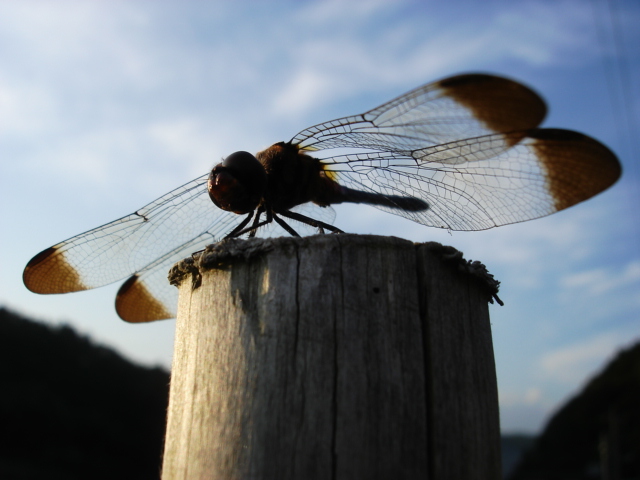
Dragonfly
Mara’s Dictionary – internet security
internet security – (n. phr.) the warm fuzzy feeling one gets when one connects to her/his internet service provider and finds it is not down due to server failure or maintenance.
See the rest of Mara’s Dictionary
Postmodernism1
The question of whether postmodernism is alive or dead is really not an issue. Because it is all about perspective. And it is about how postmodernism is used and who uses it. To put it in the negative it is about how it is dismissed it and who dismisses it.
Postmodernism isn’t dead. It is very much alive simply because we are talking about it. We debating whether it is alive is in itself to give it life. It is however different to, say, Nietzsche’s “God is dead” proclamation because Nietzsche was making a statement about the end of religion’s grip on power over us. And it is also different to saying that Elvis is dead since this is a fact (or as some may want you to believe that he is living as an old man somewhere in Florida).
But if we are to take it to mean something like Nietzsche’s declaration, that is God has no power over us anymore, then I will still have to contend the point. While it would be ridiculous to say it is trying to become the dominant discourse, it never was trying to do so in the first place. And if it did try it isn’t postmodernism. It is only a modernism in the guise of postmodern sheeps clothing. Postmodernism must therefore always be an anti-thesis to a thesis (which was an anti-thesis to something else) without ever coming to syn-thesis.
So now do you care to argue about whether Elvis is alive?
 signature103