Three books environmentally aware parents should read with their children

The movie based on Dr Seuss’s The Lorax is coming out soon.

It’s a shame we are moving towards a world which spends more time “watching” books than reading them.

Here are a few more titles which I like a lot – Farewell to Shady Glade and The Little House. Both stories are tales of the encroaching human world upon the nature we depend upon for survival. But sadly both books seems to be saying the only solution is to find another place to live, far from humans. What happens when the world becomes too crowded (like it is now) and we have no more places to run to, to take refuge in?
Our patch

The patch in winter I’d quite bare but it is still amazing that this much grows this time of the year.

(First shots from iPhone and trying direct upload.)

New Year’s resolution for SD

btw HNY.

This year’s NY resolutions are

  • meditate more
  • help the world more
  • blog more

Hope together we can do more for ourselves spiritually as well as for the world.

Art and the environment – Emma Lindsay

Artist, Emma Lindsay, is driven to speak up for the environment and our highlight our impact upon it. Watch this space for updates on this very talented artist … who happens to be a good friend.

The world economy only works if there are IMFs

Hasn’t anyone figured out that the world’s economies only ever seem to work with bailouts. Something is very wrong here.

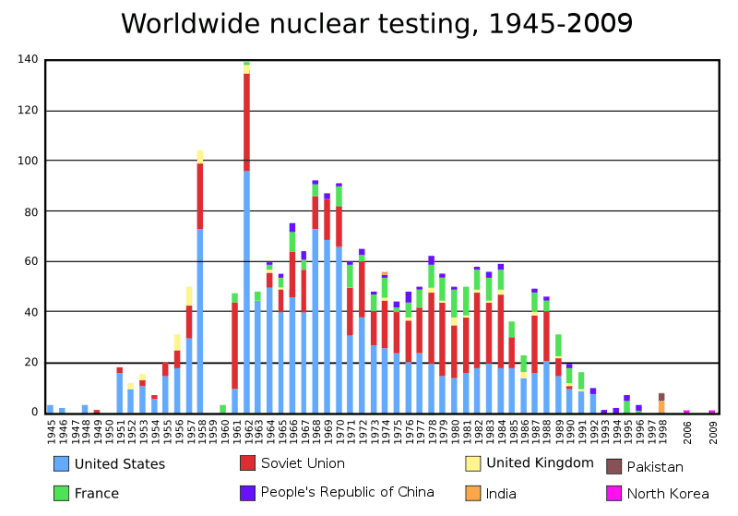
Just how many nuclear tests have we done?

Here is a art video representation of nuclear tests 1945-1998 by Japanese artist Isao Hashimoto created in 2003.

And to get up to date a graph from wikipedia showing the frequency of nuclear tests.

6,999,999,998 … 6,999,999,999 … 7 billion people … 7,000,000,001 …

Apparently we are counting down (up?) to person-number-seven-billion expected to be born on 31 October.

Our population has increased at a phenomenal rate. We reached:

3 billion in 1960,

4 billion in 1974,

5 billion in 1987, and

6 billion in 1999.

And now – 2011 – we shall reach 7 billion.

Just how many people can this little planet of ours support? As John Feeney succinctly put it growth is madness. Why we should countdown as if it is a celebration is beyond me. And if the above pattern is anything to go by we should reach 8 billion by 2022.

Will we be counting down then again? Will we be thinking this is a momentous occasion?

If the world were a food village of 100 people

This is an English translation I made of an essay called If the world were a village of 100 people: food edition by Ikeda Kayoko (ISBN 9784838770045). As far as I know it is only available in the original Japanese. There are many interesting and important facts in it, so I felt it important to get an English translation out there. This translation is under a Creative Commons Attribution-NonCommercial-NoDerivs 3.0 unported licence.


Grilled salty pike and simmered taro, with rice, miso (bean paste) soup and pickled vegetables … that was the hearty meal one have in Japan forty, fifty years ago.

Everyone had 112kg[1](*see notes at the end) of rice to eat for one year – twice as much as we have today.

Do you still think this is a poor person’s meal? Back then, Japan produced close to 80 percent of all its food needs.

And now in the twenty-first century … the world has 6.7 billion people.

If the world were a village of 100 people and we look how we live with food what do you think this would look like?

Continue reading “If the world were a food village of 100 people”

Money blinds people to nuclear risks – pro-nuclear mayor re-elected

Shigemi Kashiwabara, the mayor of Kaminoseki City in Yamaguchi Prefecture, has been reelected. He won his seat on a pro-nulcear platform. It is a shame that people still buy into carrots dangled in front of them. This was the first municipal election held in Japan since the Fukushima nuclear accident.