Nature includes us

There is an excellent account of the word “nature” in Raymond Williams’ book Keywords: A Vocabulary of Culture and Society (page 219). Three definitions of the word were listed.

  1. the essential quality and character of something
  2. the inherent force which directs either the world or human beings or both
  3. the material world itself, taken as including or not including humans beings

Example sentences of these respectively could be, for example:

  1. “The nature of the crime was too gruesome to describe.”
  2. “Nature will dictate our planet’s future.”
  3. “Man and nature have achieved harmony.”

While the oldest usage is that 1 it is used more now as 2 and 3 where differentiation is difficult between the the latter two. What is important is the inclusion and exclusion of human beings. One is to equate nature with God with a capital G (as noted by Williams). Thus 3 is close to the physical reality when man is included, but only the natural world apart from human being and human culture.

Personally, I believe nature includes us (meaning 3). Nature made us to develop ideas which includes ideas about God, nature, and culture. There is a role for the idea of exclusion as well as inclusion. We have the capacity to think and express either. The ground of battle is not in God, nature, or culture but the nature* of language itself.


*First meaning was meant and unavoidable.

Philosophical tennis

It is 2019. Thousands of people are sitting in a tennis arena, watching Roger Federer and Raphael Nadal playing tennis. Neither the existence of Roger, Raphael, the tennis balls, nor the net changes if no one is there to observe it. It does not matter if it is thousands, one or none. Roger, Raphael, and the tennis balls exist. Sensation/perception, or the lack of it, is irrelevant to their existence.

In 2020, it is possible to a no-audience policy because of coronavirus.

The insistence upon the priority and significance of perceiving and being perceived is a distraction to the act of philosophy.

Warning: if you ask me who is doing the act of philosophy then you haven’t been paying attention.

Categories

Rather than Plato’s innate ideas I think the concept of categories is a more correct model. We categorise things (physical and concepts) according to perceived like-ness and difference.

As a child I had thought dogs, lions, and tigers were of the same category (fierce and scary animals). So it was a shock when I had learned that lions and tigers are related to cats, and genetically unrelated to dogs, apart from being a mammal, of course. It was a shock to me too that humans are mammals.

There are no natural categories. We make choices from obvious (and sometimes not so obvious) traits, whatever that word means.

The Experience

The Experience is the source of all knowledge. By experience I mean sensation from the senses. The five basic senses are the eyes, ears, skin, nose, and tongue, in the modes of sight, sound, touch, smell, and taste respectively. Perception is also part of experience. Perception is the interpretation of the physical data from the senses and also the interpretation of the concepts (mental data). Conceptualisation is a part of this experience. It is the accumulation of concepts – physical and mental data – that I term knowledge. Signification (language) is the part of this experience of this particular animal.

Without sensory experience we do not have knowledge. The beginning of sensory experience is what we call life, and its end is death. Everything in between is The Experience.

Why buy physical music? Because it is better!

When was the last time you considered buying a stereo? In fact, the term “stereo” just seems so dated. Most people these days listen to music on bluetooth headphones or speakers. But they are missing out on a lot. Or if they are listening to subscription streaming audio then maybe not. Let me explain.

Subscription-based music streaming services like Apple Music, Google Play Music, Amazon Music or Spotify use low encoding bit rates. Typically a compact disc is at 1411.2 kbit/s while Apple music is at 256 kbit/s. This means a compact disc is playing 5 times more information per second than the same song streamed from Apple Music. Spotify is only slightly better than Apple in this respect at 320 kbit/s. Only Tidal and Amazon Music HD gives CD equivalent encoding bit rates. But this would also mean fives times more bandwidth is used.

But what does this all mean? Well, if you are listening to your music on the standard issue Apple headphones this does not matter much, since the headphone cannot produce the dynamic frequency range of the audio. This is also true of bluetooth speakers which not only does not cover the spectrum but also does not produce stereophonic sound well.

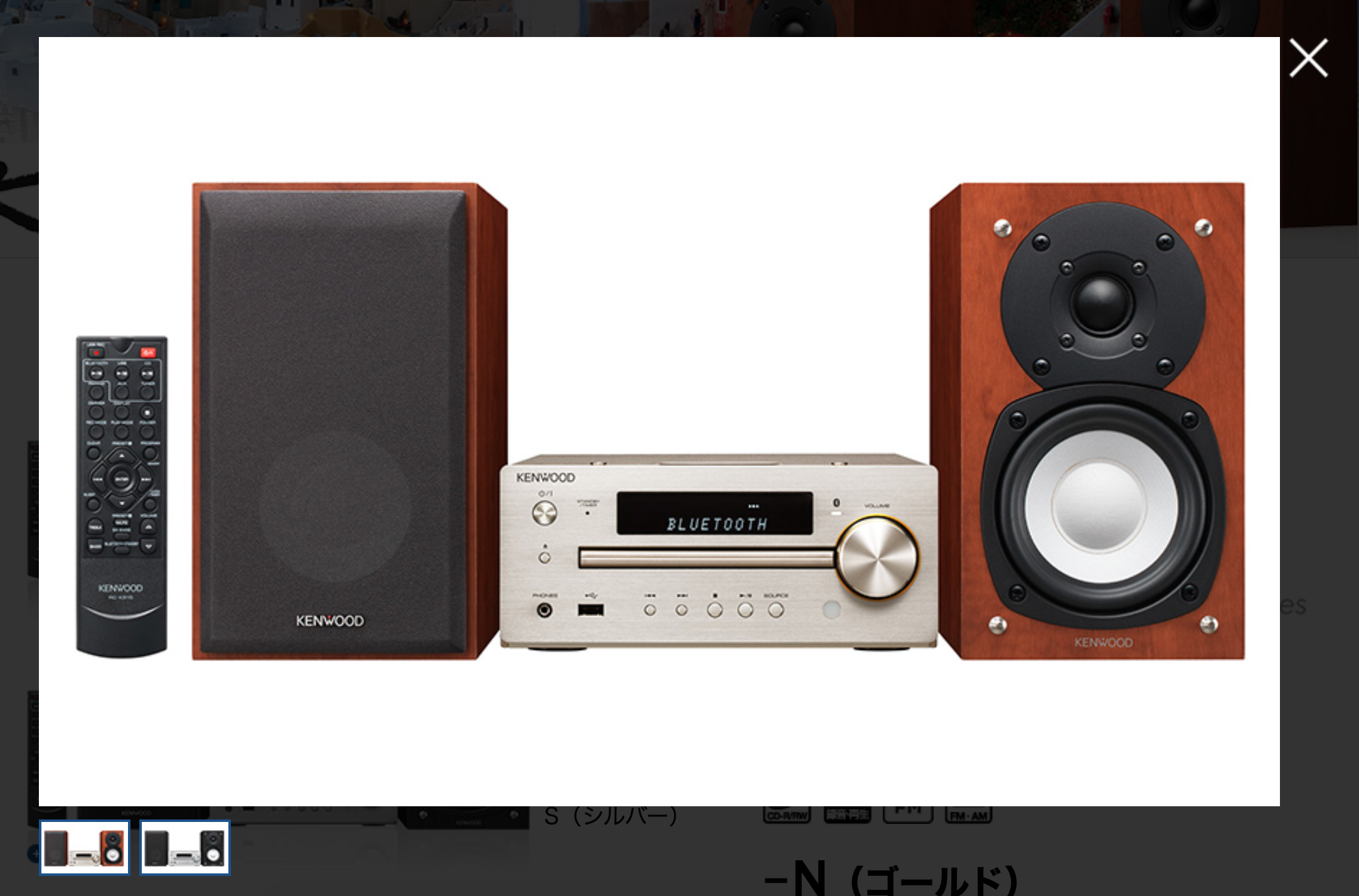
Which is why I am talking about the Kenwood K-515 here.
Screenshot 2020-03-05 15.56.56

This is a stereo or a hi-fi.

While this is a current incarnation of the old-school system it does what stereos were supposed to do – reproduce high quality high fidelity sound. You will notice in this shot that the display says “bluetooth”. So this is not an old school hi-fi with some new trick up its sleeve.

As I said, the problem is, firstly, the source of the music. If you stream Apple Music on the K-515 it sounds pretty good, in fact, much better than on standard headphones (maybe not high end bluetooth headphones). But it will beat the bluetooth speaker hands down.

There is something about stereophonic sound created by two speakers. It has depth. It isn’t mono.

It gets better
But not only do we have stereo we can also play back more information. Playing a compact disc version side-by-side with a streamed version one will notice that the sound is also richer with the CD. The loss of information depth (if you will) means the “in between” sounds are lost. This why we should return to at least CDs. There was/is nothing wrong with CDs at all.

What went wrong with music was music piracy and then download purchase model. Yes, Napster made sharing music a whole lot easier. That started the decline. But Also, as a knee-jerk reaction, download purchase of music also meant people no longer bought albums, but individual tracks. In other words, sales of music moved towards singles. This lowered volume of sales thus hurting the artists.

How to view streaming in 2020
So, is streaming bad? I don’t think so. Whereas I used to visit the record stores regularly to see what was new and randomly discover music and artists I like, this did not happen once physical sales disappeared. That is, until subscription streaming.

With a subscription service it is now like having a listening booth in your house. But after I had bought the K-515 the quality of the recording began to matter again. Simply, I have now returned to buying CDs and records because they sound so much better. Occasionally I buy hi-resolution tracks online but nothing beats having a physical album.

When you buy an album you are buying more than just the music. You are buying the artwork, the additional relevant information, and the knowledge that it is yours forever. that is part of what music means. People spent a lot of time thinking about the cover art and design of the album. This is part of what music is about.

Apart from there being very little price difference between downloaded album and physical one you get nothing but the music with download. Someone is pocketing that money for so much less work. Physical albums, comparatively, are value for money.

I have not enjoyed listening to music in such a long time, all it took was an investment in the right equipment and an understanding why a good source and hardware are necessary.

Incidentally, that stereo cost the same as a “high-end” bluetooth speaker. So, why would I want to buy a (mono) speaker when I can have a stereo? None, whatsoever.

Sacred dance, festival

In the background, others prepare while she performs. The drummer can be seen in the back left.

Back to basics with music – buy a “stereo” stereo

I believe we have forgotten the fundamentals of music.

Sound is three-dimensional, and embodied. We have not one but two ears for a reason. Sure, stereo headphones will produce stereo but not three-dimensional sound. The stereophonic sound remains the same even if you move your head to face any direction. Not so with live performances or speakers spaced apart.

While it can be argued that an all-in-one unit player/speaker is located in a space it does not produce stereophonic sound very well. Firstly, the speakers are too close together. Whatever stereo sound you have it may as well be a single speaker. Secondly, today’s digital streaming music is less detailed and dynamic than the original recordings. The combination of these make for a flat and unenjoyable music experience.

It is a mistake to think playing music loud will make it more dynamic or detailed. If the data is missing detail (and therefore dynamic) no matter how good your equipment is, it will output only what it is input into it.

This means there are at least four factors which will determine how good the music will sound. These are 1) the recording equipment; 2) the amount of data preserved; 3) the processing unit or amp; and 4) the speakers.

I have a recording of Rachmaninoff playing his own Piano Concerto No. 2 but because it was recorded in the early 20th century the amount of detail is low. Similarly, the standard digitally streamed music is of a lower sample rate as well as bitrate. Both of these impact on what can be reproduced. Today while I have a decent stereo in the form of the Kenwood K-515 it still produces, in the eyes of an audiophile, well under the kind of sound that can be considered optimal or perfect. But then again, I am not spending thousands but hundreds of dollars here. For the price I paid that is good enough for me.

Buying a DSD recording of Norah Jones’s Don’t Know Why and playing that on the stereo made it so wonderful that I must say that it was value for money.

Within the limits of a game of tennis is philosophy

Idealism suggests that there is the mind only. If this being the case then the world (things, space, and time) could and would be known without the senses (eyes, ears, nose, mouth, and skin). Clearly, to know the world we need the senses and also a capacity for thought – the mind. Berkeley argued for a reason-only position. Again, the same problem can be pointed out against him or her.

Bu the materialist position is not any better. If there is only matter then how do account for knowledge? Obviously, we need the senses and reasoning of sense-experiences. Here, Kant is correct that we need to combine knowledge from the senses with interpretation from reasoning. But the reasoning should lead us to ontological question again of what exists, not only that we have only phenomena (representations) to work with. Ignoring what actually exists is to live a life not fully engaged with the world.

This is why I bring up a game of tennis as example. Tennis players, umpires, spectators all know the qualities and properties of the world and engage in competition, judgement and enjoyment of it. Without this trust of the world we would be forever wondering if the laws of the game would change, or will the ball disappear and reappear elsewhere on the court. And that would not be enjoyable for anyone involved.

The things and qualities of the world have been consistent in my life time. And my lifetime is not a particularly special or different one to any other person’s in any time or place. And if it is different, then, that is the reality, and that this difference must be accounted for. What remains is the thing, the body. What cannot be account for is the mind, soul, or spirit. If it not there to begin with, it wasn’t there then either.

And for this reason I argue the material monist position. What is called, in the least, the mind, soul, and spirit supervenes to the body. In all likelihood the mind, soul, and spirit does not exist, that is, they are illusions.

white paper from the start

a blank slate
or white paper –
our minds are
from the start
like this.

a mind
without sense-experience
will continue to be
a blank slate.
no perception,
conception, or signification
is possible
unless
we have
the initial
sense-experience.