Keep Calm
blog
 When the nun Chiyono studied Zen under Bukko of Engaku she was unable to attain the fruits of meditation for a long time.
At last one moonlit night she was carrying water in an old pail bound with bamboo. The bamboo broke and the bottom fell out of the pail, and at that moment Chiyono was set free!
In commemoration, she wrote a poem:
In this way and that I tried to save the old pail
Since the bamboo strip was weakening and about to break
Until at last the bottom fell out.
No more water in the pail!
No more moon in the water!
(From Zen Flesh, Zen Bones)
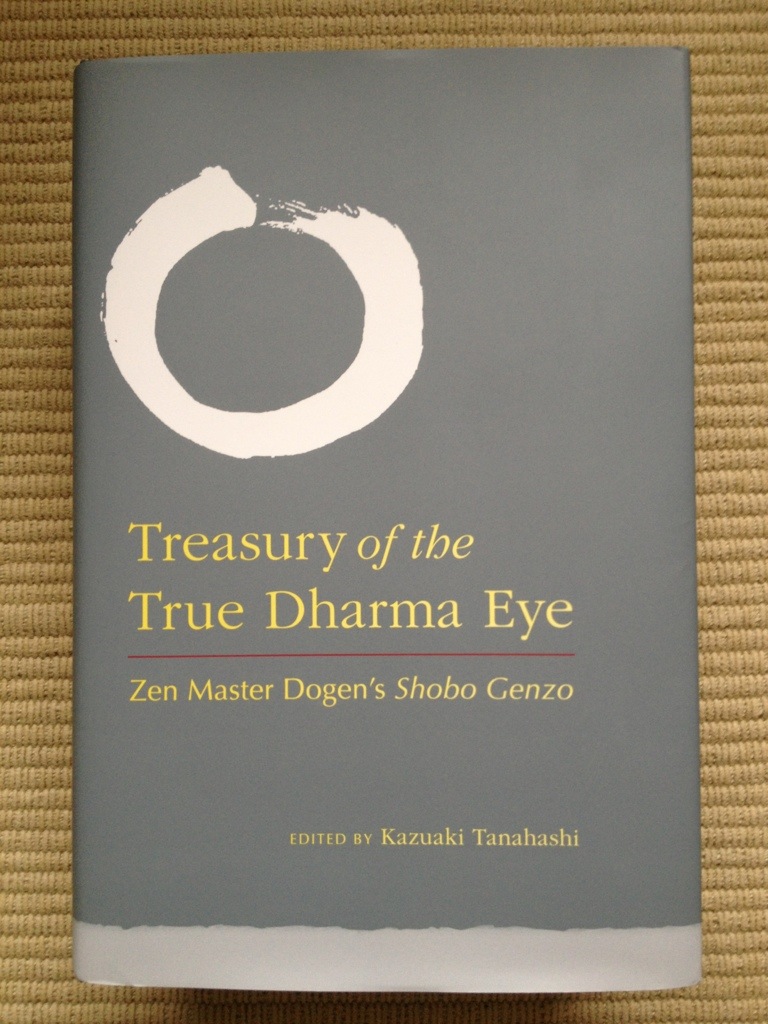
Just bought this complete translation of the Treasury of the True Dharma Eye. Last year the publishers released a beautiful two-volume boxed hardcover edition of which I really regret not purchasing.
Go where
The wind blows
Far into the interior
Of the mind
Of your haiku
Then beyond
Its borders
Through towns
Pass common folks
Over seas
And in love
With your
Companion
Only to return
To reality
That is the Edo.
every moment
is simultaneously
a small death
and rebirth
clockwise ascent
more progression
sideways, slow
doesn’t describe you
procession of souls
cabinet
as life
views far
beyond mountains, seas
sees before again
gentle decline
setting
your anticipation
a rebirth
before next ride
Old pond
A frog leaps in –
Sound of the water
Furu ike ya
Kawazu tobi komu
Mizu no oto
Perhaps the most well known haiku.
Often said to embody all that is Zen in it, the old world and now are linked by the sound of the water.
I wrote a poem which goes like this:
There is no old pond.
There is no frog that leaps in.
No sound, no water.
This is a pale imitation of the style of the old masters like Mumonkan or Hakuin. Our fixation with the old pond, the frog and the sound will ultimately undo us. To reach enlightenment it is necessary to forget – so to speak – these things which belong to the mind’s illusion.
There is a koan – Case #3 in the Mumonkan – that is similar:
“The Zen master Gutei used to raise one finger as a gesture of Zen. Once a visitor asked Gutei boy attendant what does his master teach. The Boy raised his finger. Master Gutei hearing this cut off the boys finger. In pain, the boy ran crying. The boy called by his master turned, only to see the master riase his finger. At that moment the boy was enlightened.”
I doubt Gutei really cut his finger off and so the boy was also crying in mock. But doubtless was his enlightenment.
The point is Gutei’s teaching has nothing to do with the finger or the gesture. So the boy’s raising of the finger has no meaning, no power. It is as ordinary as Gutei’s gesture. But Gutei’s gesture has all the ability to bring about enlightenment, as does Basho’s poem, but no the boy’s finger.
Why should this be so? If you can say then you have glimpsed something.
One further note: the visitor to Gutei no doubt was pushing the boy. He had seen something in him. He knew he needed one more nudge to be pushed over the edge. In other words this was no ordinary visitor but someone with insight. Zen koans and their dialogues are not accidental. They are carefully orchestrated for the benefit of the student, to bring about enlightenement in him or her.
 Here is an excellent documentary of my master, Harada Tangen Roshi, made by zen practitioner, artist and filmmaker, Madelon Hooykaas. She practiced under him 30 years ago and made this film in 2008 or 2009.
There is no old pond.
There is no frog that leaps in.
No sound, no water.
Into
My begging bowl too
Fall hailstones
Teppatsu no
Naka e mo
Arare
teppatsu (steel begging bowl)
no naka e (falling into the)
mo (also)
arare (grain-sized hail)
A teppatsu is a steel bowl for receiving alms from begging or takuhatsu. Begging is an important part of Buddhist practice. Not only should the receiver, the monk, be thankful but also should the giver, the lay people. People often think that takuhatsu is a base practice but it is really the highest of practices in Buddhism. Takuhatsu is different from begging. The begging of the poor is seen as receiving something for nothing. But in the takuhatsu the giver is also receiving the Teaching of The Buddha from those practicing towards enlightenment. Thus the monks hard work is not only for himself but for others as well. So the receiver and giver both should have a spirit of gratitude for this reason.
The e in the second line is a grammatical particle in the Japanese language. It is possible to replace the e with a ni for the sentence to still remain grammatically correct. But there is a difference in meaning, in nuance. E denotes a movement whereas ni denotes a state of existence. With a ni the sentence would then translate to ‘In my begging bowling too are hailstones’. The cruciality of the movement thus signifies the striking of the metalic bowl by the hail, making a sound which brought probably Santoka to some kind of great realization.
For it to be hailing it must have been during the cold winter months. How hard and lonely it must have seem for Santoka. Yet his poem is full of joy and gratitude. How wonderful is the Teaching! How powerful it is! How deep his realization!
It should also be noted that Santoka is famous for his free-form haiku. While the haiku is usually 5-7-5 in syllables this haiku is 5-4-3 departing radically from the norm. Furthermore it is standard to have a season word or kigo. Here the season word is hail but Santoka may not put one in. This freedom of style is powerful and natural for him, making his poetry closer to modern verse. Indeed he lived in a time (1882-1940) of great change in Japan.
 signature103