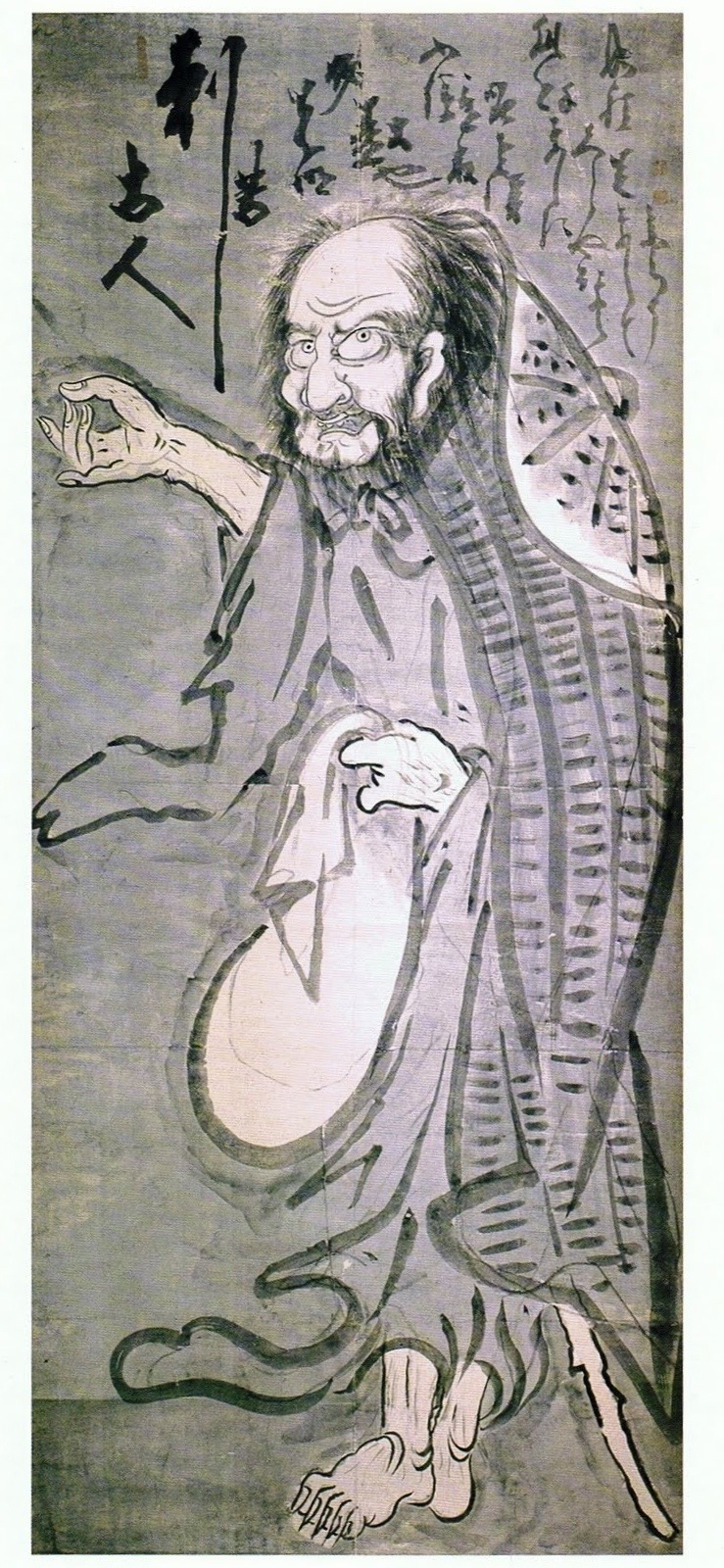
Daito Kokushi by Hakuin
blog
Death, of course
Is the sure bet
But you are either
The horse
Or the punter, and
Never both at once.
death
is not such a scary thing
not completely unexpected
it happens to everyone
it is the sure bet
so why do we fear it
it’s as natural as birth
to be born is
to be guaranteed a death
a wise man once said
‘what is unborn cannot die’
how wonderful it is, then
to be born and not live forever
because how boring
would life be
as beckett put it, to be
waiting for godot

Just as losing weight and saving money need to be achieved by oneself so to Enlightenment.
Although over two months have past for 2013 already I had made a resolution this year but not posted about it.
This year I have one resolution only – to be able to recite the Hannya Shingyo (Heart Sutra) by heart. This has been something I haven’t been able to do. There are sections which I don’t remember or else I get the order muddled. Conscious focus is necessary for anything. So you can say I have not been mindful in this case.
Where does anger come from?
Perhaps this is poorly phrased,
An inappropriate metaphor.
For something to come and go
It must be real.
But anger isn’t real.
If I understood that, then
The world would be
A much better place for you
Me and everybody else.
sentiment
need not follow
form
What is the ‘no’ in ‘no form’?
This ‘no’ is not the no in the phrase ‘I have no money’. Whether one has money or not is not of importance. The ‘no’ is rather like the ‘-less’ in ‘priceless’ meaning ‘beyond a value’ where it is not attached to existence or non-existence.
And what is the ‘form’ of ‘no form’? It the very way our physical body works. The heart pumps. The blood flows. Rhythm follows. We breathe. We grow. And we change. But to go beyond this understanding of good and bad is the meaning of the phrase ‘no form’.
It is this life, this reality, without principles, without discrimination that we have simply overlooked.
We should be attentive to the ‘no form’ which is without attachment in all its working.
(My translation of Choyaku Hannya Shingyo, pp88-9, by Sakaino Katsunori, ISBN 9784837981619)
Even Buddhism is not immuned to problems. Was Sasaki Sensei enlightened? I doubt it.
I started out in Buddhism with Zen Buddhism. I think it has a lot to offer. But at the same time one should think about what it doesn’t offer. One should weigh the pros and cons.
One of the interesting developments in Mahayana Buddhism (of which Zen is a part of) is that of the Bodhisattva and its (it is both a he and she. And it is a non-existent person) ideal. A bodhisattva is said to strive to save all beings before its leaves this world into Nirvana, the final extinction.
In contrast the Theravada has the Arhat ideal. An Arhat is anyone who has vowed to become enlightened, the highest ideal that leads to contentment. Mahayana sees the Arhat ideal as selfish which is why they developed the Bodhisattva ideal. This was a later development after the Buddha’s time.
So if you ask me which is “correct” I will say both.
I doubt The Buddha meant for his teaching to be selfish (the supposed Arhat ideal interpretation) in any way. But neither did he mean for it to be an active and engaging teaching (the Bodhisattava interpretation) either.
 signature103