What is it like to transform the world around you for the better? If you want to know listen to this inspiring talk by Patrick Awuah about his work to positively transform Ghana and the African continent.
Author: Warren Tang
I write about linguistics and philosophy. I also write poetry and take photographs.
Some thoughts on the Arhat and the Bodhisattva
I started out in Buddhism with Zen Buddhism. I think it has a lot to offer. But at the same time one should think about what it doesn’t offer. One should weigh the pros and cons.
One of the interesting developments in Mahayana Buddhism (of which Zen is a part of) is that of the Bodhisattva and its (it is both a he and she. And it is a non-existent person) ideal. A bodhisattva is said to strive to save all beings before its leaves this world into Nirvana, the final extinction.
In contrast the Theravada has the Arhat ideal. An Arhat is anyone who has vowed to become enlightened, the highest ideal that leads to contentment. Mahayana sees the Arhat ideal as selfish which is why they developed the Bodhisattva ideal. This was a later development after the Buddha’s time.
So if you ask me which is “correct” I will say both.
I doubt The Buddha meant for his teaching to be selfish (the supposed Arhat ideal interpretation) in any way. But neither did he mean for it to be an active and engaging teaching (the Bodhisattava interpretation) either.
Bodhisattva and reincarnation
The goal of Buddhism whether Theravada or Mahayana is to end suffering. By doing so one ends rebirth or reincarnation.
Yet in Mahayana Buddhism the ideals of a the Bodhisattva is to delay one’s entry into Nirvana and return or reborn to help save all others.
In this sense Mahayana Buddhism is active and Theravada is passive.
As a Buddhist this is an important question. It is a question which ultimately will determine how you approach the way you live.
How we (are not supposed to) solve our economic problems

Moderation in eating
At my annual medical checkup the doctor told me that I need to lose weight. Not much – 3-5 kilograms. I am borderline ‘metabolic’ as he put it. He said ‘reduce your food intake and do exercise’. Moderate exercise I do but reducing my food intake has been a tough one. I don’t eat that much already. To reduce anymore seems all the more difficult becasue of I will have nothing to eat.
It is said the sloth (the furry tree-dwelling animal) moves as slowly as it does in order to conserve precious energy. This means it doesn’t require as much food also. Your intake should reflect your expenditure, I guess.
Now what the doctor was saying is very Buddhism – we need moderation. Obviously I am taking in more calories than I need to otherwise my body would not need to store it up as fat. So let’s see how I go with my diet in the next year.
The rebirth of sustainability dharmablog
Change is inevitable. Change is natural.
It is believed in Zen that every moment is a death. We die and change without knowing it. It is the grand illusion of of life. Some will go as far to say without being enlightened we are living as though we are dead.
So too sustainability dharma must end and be reborn as sustainability dharmablog. If you have hung around this blog long enough you will know it used to be ‘sustainability dharma blog’ (with a space) before it became ‘sustainability dharma’. I had dropped the ‘blog’ bit. Now I am reinstating it but as one word, not a compound.
This blog will now focus on Buddhism exclusively. It is not that I am not concerned about sustainability but that I am not going to write about it anymore. That is all. Gassho.
Life in a Zen Temple #1 – Daily Schedule
This was the schedule at Bukkokuji in Obama, Japan:
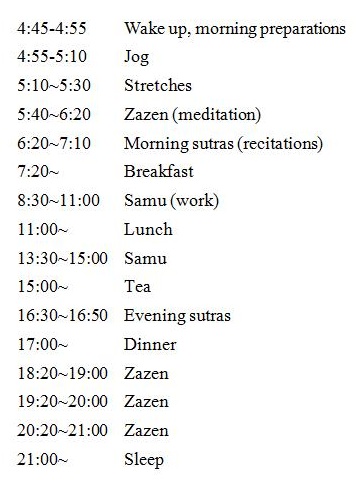
All work activities were done in silence as much as possible. When we work we should be mindful as we would during meditation. There is no separation between the effort on the cushion and other activities.
The Last of the Snow – Tetsuo Sakurai
Along the road
In the last of the snow is a gravestone.
The valley wind clings to it.
The voice of the twenty-six year old wife
Who died after surgery
The voice of the daughter ten hours after the operation …
The last of the snow will fade
Towards the coming spring.
In the warmer months I will come again.
(My translation)
Tetsuo Sakurai, poet.
We [sufferers of leprosy] have been segregated, true. That was something the laws did, and we could not do anything about it. Yet even when your body is segregated, there is no need for your mind to also be confined, is there? If that happens, it is just too sad . . . . I just want someone to know that I have existed, and have lived here. I do not want to die quietly, without anybody knowing about it.
— Tetsuo Sakurai, Poet, Japan, who has been isolated from society for most of his life due to leprosy
The strength of true human spirit. Sometimes we feel alone and it is society which does that to you. But those who understand it is not about the body will find strength from within.
Maximum Wage – the New Middle Way
Now here is an interesting (but not so new) idea.
While we often talk about what should be the minimum a person should earn for good standard of living we never talk about what is the maximum someone really needs. The term may be a great play on words it isn’t an empty concept. In essence it is the idea of moderation. The phrase “maximum wage” may be a catchy term but why should we adopt the ‘floor-only’ way of thinking and not a ‘ceiling-also’ philosophy? We have been tricked by the rich to think that they have been looking out for the underdogs when really they have been looking out for themselves.
 signature103