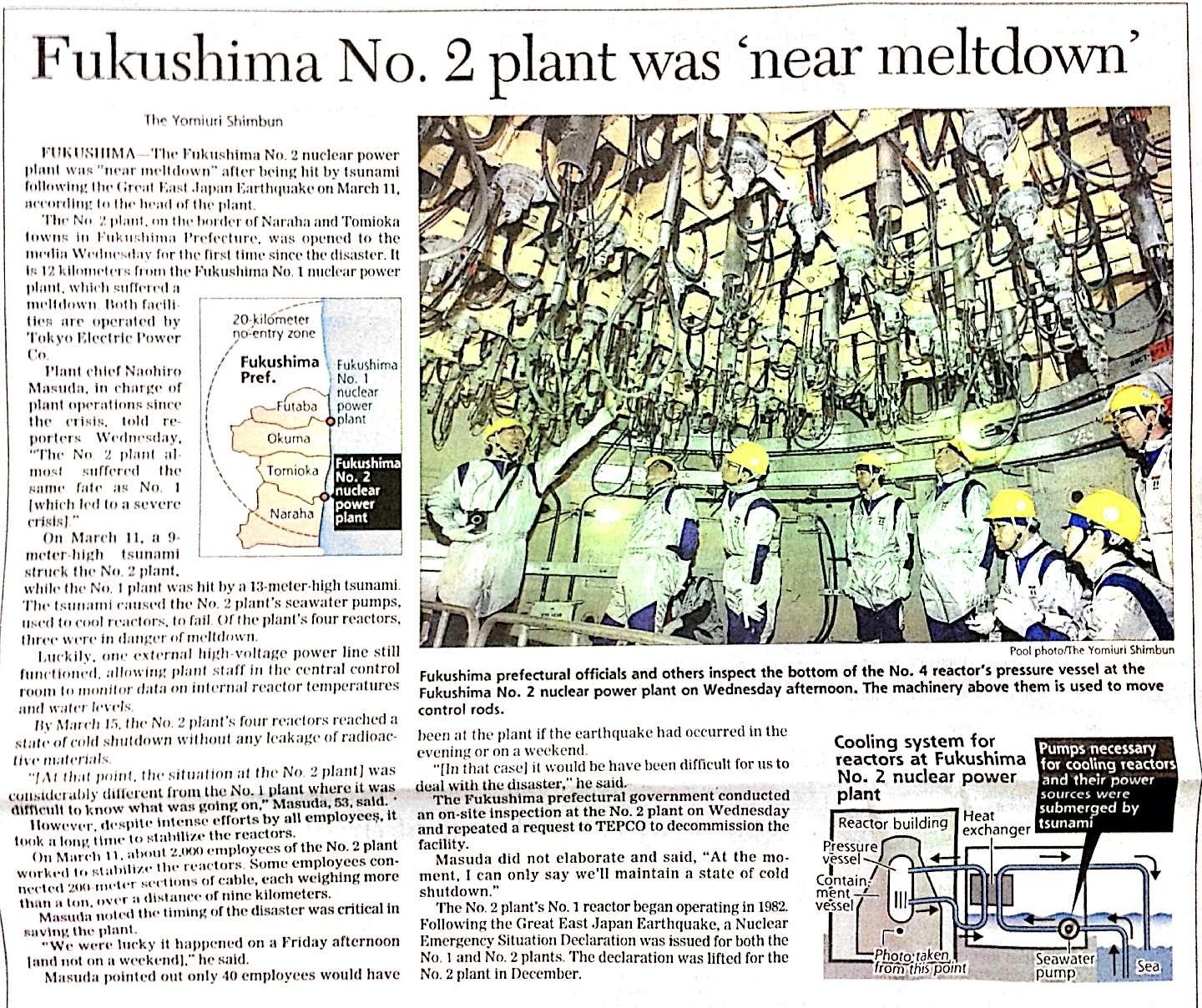
3-11 nuclear disaster could have been much worse
blog
 The patch in winter I’d quite bare but it is still amazing that this much grows this time of the year.
(First shots from iPhone and trying direct upload.)
btw HNY.
This year’s NY resolutions are
Hope together we can do more for ourselves spiritually as well as for the world.
Having started out Buddhism from Zen Buddhism (and now with a bit of Theravada) I cannot fathom what drives some monks to think they can run a bar and still think they can still call themselves Buddhist monks. It wasn’t mentioned which sect these monks belong to but my guess is that they are from the Jodo Shin sect.
I am not against Jodo Shin sect at all but rather misinterpretations by people of what its original founders had intended. Like all societies and their religions there will be radical offshoots. Is it okay to start a prostitution house just because you have a sympathetic ear?
A line has to be drawn somewhere and it has to be drawn with common sense even though common sense can be problematic at times.
Artist, Emma Lindsay, is driven to speak up for the environment and our highlight our impact upon it. Watch this space for updates on this very talented artist … who happens to be a good friend.
Hasn’t anyone figured out that the world’s economies only ever seem to work with bailouts. Something is very wrong here.
Did you know that 40% of world’s civil or internal wars in the last half century have been fought over for natural resources?
Today is International Day for Preventing the Exploitation of the Environment in War and Armed Conflict. We should remember the (illogical) reasons why we are fighting in the first place. Then, may be, we will put down our weapons and make peace instead.
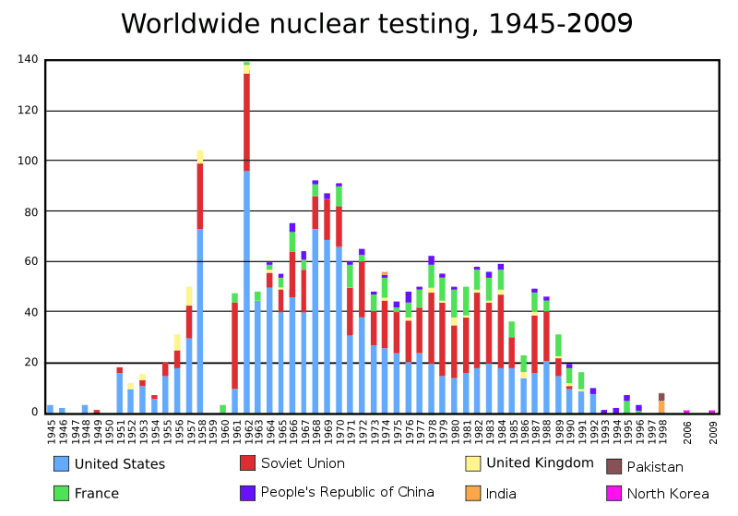
Here is a art video representation of nuclear tests 1945-1998 by Japanese artist Isao Hashimoto created in 2003.
And to get up to date a graph from wikipedia showing the frequency of nuclear tests.
Apparently we are counting down (up?) to person-number-seven-billion expected to be born on 31 October.
Our population has increased at a phenomenal rate. We reached:
3 billion in 1960,
4 billion in 1974,
5 billion in 1987, and
6 billion in 1999.
And now – 2011 – we shall reach 7 billion.
Just how many people can this little planet of ours support? As John Feeney succinctly put it growth is madness. Why we should countdown as if it is a celebration is beyond me. And if the above pattern is anything to go by we should reach 8 billion by 2022.
Will we be counting down then again? Will we be thinking this is a momentous occasion?
This is an English translation I made of an essay called If the world were a village of 100 people: food edition by Ikeda Kayoko (ISBN 9784838770045). As far as I know it is only available in the original Japanese. There are many interesting and important facts in it, so I felt it important to get an English translation out there. This translation is under a Creative Commons Attribution-NonCommercial-NoDerivs 3.0 unported licence.
Grilled salty pike and simmered taro, with rice, miso (bean paste) soup and pickled vegetables … that was the hearty meal one have in Japan forty, fifty years ago.
Everyone had 112kg[1](*see notes at the end) of rice to eat for one year – twice as much as we have today.
Do you still think this is a poor person’s meal? Back then, Japan produced close to 80 percent of all its food needs.
And now in the twenty-first century … the world has 6.7 billion people.
If the world were a village of 100 people and we look how we live with food what do you think this would look like?
Continue reading “If the world were a food village of 100 people”
 signature103