The answer to life and everything is … 8.7 million

That is how many species there are on the planet.

At least this is the best estimate we have, plus or minus one million.

Of these only 1.2 million have been described, most of which are of land lifeforms. This equates to 14% of land life and 9% of ocean life that we have a name for.

We really know very little about ourselves and our planet.

How feasible is green energy?

According to Japan’s Ministry of Economy, Trade and Industry the country’s energy from renewable sources accounted for only 1 percent of the total energy gneration in 2009. And that number has improved in much 2011 though efforts, verbally at least, have increased due to the Fukushima Incident.

Why is this so? Well, it takes area of 65 square kilometers of solar panels to generate the same amount power of one nuclear reactor. Now that is not efficient, is it? The same problem goes for wind power generation. And we have yet to talk about the cost here.

No, the aim for 20% of energy from renewable sources by 2020 in Japan just seems near impossible though an accident of the size we had in Fukushima may well change that. One has to ask why must we wait for such things to happen before we act.

First Peace Declaration since the Fukushima Nuclear Accident

HIROSHIMA, 6th August  2011. From Kyodo News

The following is the full text of the Peace Declaration issued Saturday by Hiroshima Mayor Kazumi Matsui at a memorial ceremony to mark the 66th anniversary of the atomic bombing of Hiroshima.

Sixty-six years ago, despite the war, the people of Hiroshima were leading fairly normal lives. Until that fateful moment, many families were enjoying life together right here in what is now Peace Memorial Park and was then one of the city’s most prosperous districts. A man who was 13 at the time shares this: ”Aug. 5 was a Sunday, and for me, a second-year student in middle school, the first full day off in a very long time. I asked a good friend from school to come with me, and we went on down to the river. Forgetting all about the time, we stayed until twilight, swimming and playing on the sandy riverbed. That hot midsummer’s day was the last time I ever saw him.”

The next morning, Aug. 6 at 8:15, a single atomic bomb ripped those normal lives out by the roots. This description is from a woman who was sixteen at the time: ”My 40-kilogram body was blown 7 meters by the blast, and I was knocked out. When I came to, it was pitch black and utterly silent. In that soundless world, I thought I was the only one left. I was naked except for some rags around my hips. The skin on my left arm had peeled off in 5-centimeter strips that were all curled up. My right arm was sort of whitish. Putting my hands to my face, I found my right cheek quite rough while my left cheek was all slimy.”

Their community and lives ravaged by an atomic bomb, the survivors were stunned and injured, and yet, they did their best to help each other: ”Suddenly, I heard lots of voices crying and screaming, ‘Help!’ ‘Mommy, help!’ Turning to a voice nearby I said, ‘I’ll help you.’ I tried to move in that direction but my body was so heavy. I did manage to move enough to save one young child, but with no skin on my hands, I was unable to help any more…’I’m really sorry’…”

Such scenes were unfolding not just here where this park is but all over Hiroshima. Wanting to help but unable to do so — many also still live with the guilt of being their family’s sole survivor.

Based on their own experiences and carrying in their hearts the voices and feelings of those sacrificed to the bomb, the hibakusha called for a world without nuclear weapons as they struggled day by day to survive. In time, along with other Hiroshima residents, and with generous assistance from Japan and around the world, they managed to bring their city back to life.

Their average age is now over 77. Calling forth what remains of the strength that revived their city, they continue to pursue the lasting peace of a world free from nuclear weapons. Can we let it go at this? Absolutely not. The time has come for the rest of us to learn from all the hibakusha what they experienced and their desire for peace. Then, we must communicate what we learn to future generations and the rest of the world.

Through this Peace Declaration, I would like to communicate the hibakusha experience and desire for peace to each and every person on this planet. Hiroshima will pour everything we have into working, along with Nagasaki, to expand Mayors for Peace such that all cities, those places around the world where people gather, will strive together to eliminate nuclear weapons by 2020. Moreover, we want all countries, especially the nuclear-armed states, including the United States of America, which continues its subcritical nuclear testing and related experiments, to pursue enthusiastically a process that will abolish nuclear weapons. To that end, we plan to host an international conference that will bring the world’s policymakers to Hiroshima to discuss the nuclear nonproliferation regime.

The Great East Japan Earthquake of March 11 this year was so destructive it revived images of Hiroshima 66 years ago and still pains our hearts. Here in Hiroshima we sincerely pray for the souls of all who perished and strongly support the survivors, wishing them the quickest possible recovery.

The accident at Tokyo Electric Power Co.’s Fukushima Daiichi Nuclear Power Station and the ongoing threat of radiation have generated tremendous anxiety among those in the affected areas and many others. The trust the Japanese people once had in nuclear power has been shattered. From the common admonition that ”nuclear energy and humankind cannot coexist,” some seek to abandon nuclear power altogether. Others advocate extremely strict control of nuclear power and increased utilization of renewable energy.

The Japanese government should humbly accept this reality, quickly review our energy policies, and institute concrete countermeasures to regain the understanding and trust of the people. In addition, with our hibakusha aging, we demand that the Japanese government promptly expand its ”black rain areas” and offer more comprehensive and caring assistance measures to all hibakusha regardless of their countries of residence.

Offering out heartfelt condolences to the souls of the A-bomb victims, reaffirming our conviction that ”the atomic bombing must never be repeated” and ”no one else should ever have to suffer like this,” we hereby pledge to do everything in our power to abolish nuclear weapons and build lasting world peace.
Is this what is called “river kill”?

I drive a lot more than I would like to.

Because my wife’s place of work is a non-selectable one she has to stay put far more than I would like. Which means I have to live where I live and commute to where I can find work.

Driving a lot means I also have a lot of what I like to call “micro” road kills. The front of my car and the wind shield is a graveyard of dead splattered bugs. I have a problem with this because being a Buddhist I have to live by the precept of “Do not kill”. Yet this is easier said than done.

If I were to be true to the word of non-violence to all living organisms then I would have to live like a Jain. I myself would feel better about it but my family would have a fit. It may be extreme but it is a morally rigorous and therefore attractive.

The amount of life I take on the road makes me feel guilty. It seems everything we do seems to affect the animals we share the planet with. The dilemma is one I have no answer but one I must ponder on nonetheless.

An important lesson from Fukushima

It is simply heartbreaking to see what had happened in north-eastern Japan. Devastation by nature I can deal with. But unnecessary deaths from individual and collective action, I cannot.

Are the risks from nuclear energy worth this? As individuals we should not be indifferent but speak out when those who want to build these dangers, these nuclear power generation facilities. Sure we have a good life for while but we must question the wisdom of the reliance on infrastructures which as individuals we cannot control.

I still prefer to imagine a lifestyle which is “local”, which can be controlled or at least by managed by a small collective. Any larger and we will need to depend on something which is not dependable and maintainable by us.

By the time we realise it might be too late.

Masao Senzaki to head new nuclear nonproliferation centre

According to the Daily Yomiuri newspaper former physicist and and diplomat, Masao Senzaki is to head the new Support Center for Nuclear Nonproliferation and Nuclear Security for Asia.

He said Japan has a crucial role to play achieving US president Obama’s lofty goal of creating a world without nuclear weapons, and that our experience of using nuclear energy for peaceful purposes should be a valuable example [to other countries].

Bikini Atoll mayor to visit Japan on H-bomb anniversary

According to the Daily Yomiuri newspaper the major of Bikini Atoll, Alson Kelen, will visit Japan, on the anniversary (1 March 1954) of the hydrogen test which exposed the Bikini Atoll locals and the crew of a Japanese fishing boat from Shizuoka Prefecture.

The Japan Council Against Atomic and Hydrogen Bombs (Nippon Gensuikyo, 日本原水協) said Mayor Kelen attending a gathering here will meet the Mayor of Yaizu, Shizuoka Prefecture, where the affected ship and crew were from.

We know so little about us

Almost daily we are learning something new about ourselves, the human species.

The branch that is known as homo sapiens sapiens has taken a new twist with the discovery of remains of a new human species in Russia dubbed Denisovans. Together with Neanderthals, Flores, us, and now the Denisovans we have a new picture of our ancestry.

From our DNA it is clear that we interbred with Neanderthals. Surprising is that we also interbred with Denisovans evidenced in Melanesian DNA.

This shouldn’t be surprising to us but as complacent and too intelligent our for own good that we want to believe we are some how different to other animals (for that is what we are) that our genes is pure somehow, is a ridiculous notion to say the least.

Like it or not we are have a mixed gene pool here, perhaps for the better. Diversity is an important feature of the machination of evolution. We should not dismiss but embrace our past. After all our distant relatives were apes and monkeys. To say they are inferior is to say we are inferior which obviously we are not (though this can be disputed).

An open statement to Aung San Suu Kyi and the Burmese people

I can imagine how Aung San Suu Kyi feels.

As a parent I can relate to how she feels when seeing her son again. It must be hard (this is an understatement) but it is doing is for her country, for her people, for freedom. And I admire her, her son and the Burmese for that.

Her release may bring joy to her supporters for now but the fight isn’t over. For Burma is still in the clutches of a brutal totalitarian regime. She knows this and still chooses to stay to fight. That is truly courageous.

I pray for her and for the people of Burma.

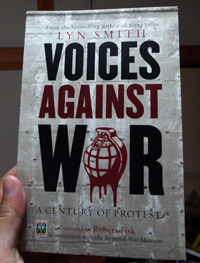
Book Introduction – Voices Against War: A Century of Protest

Voices Against War: A Century of Protest by Lyn Smith, 2010, Mainstream Publishing.

Voices Against War is a collection of transcript interviews of testimonies by conscientious objectors (“conchies” as referred to by the author’s father or COs) spanning from 1914-2009. The interviews are taken largely from the Imperial War Museum‘s archives with a forward by war correspondent, Robert Fisk.

According to the book’s blurb Lyn Smith is a university lecturer and oral history interviewer. She is the author of Remembering: Voices of the Holocaust, Pacifists in Action and Young Voices.